
Too early = unfinished source. Too late = nobody care anymore. How studios navigate adaptation's impossible dilemma.
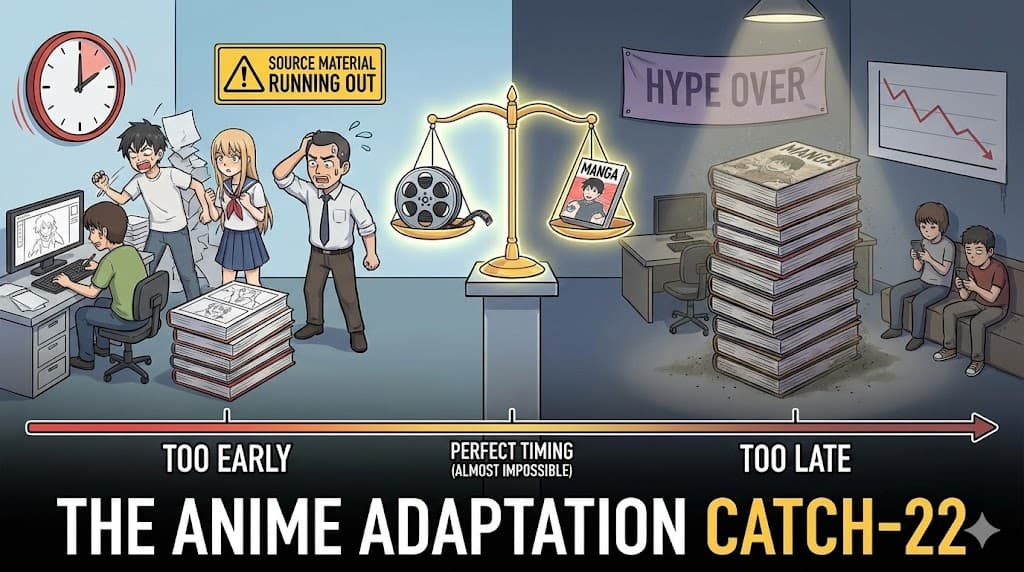
Manga gets adapted into anime typically 2-4 years after major success. Sounds sensible. Lots of time to plan, right?
Actually, it's a trap.
The timing window for anime adaptation is brutally narrow. Start too early, your anime catches and passes the manga. Start too late, the cultural moment has passed and nobody cares. Start at exactly the right time and production issues still destroy you.
Let's break the adaptation game and why it's nearly impossible to win.
Here's what studios want:
On paper, easy. In practice? Near impossible.
If studios greenlights anime adaptation when manga has only 30-50 chapters:
The anime catches the manga: Production takes 2 years. Manga might only advance 50-100 more chapters. Suddenly anime is catching plot that hasn't fully developed. Do you adapt unfinished storytelling? Do you invent filler? Do you dramatically change pacing?
Result: Attack on Titan (original anime) spent entire final season figuring out how to handle manga that was simultaneously writing its ending. Bleach's anime ended before the manga did. Both created narrative problems because timing was off.
Recent example: Kaiju No. 8 anime adapted manga that's still midway through story. Anime pacing assumes certain plot developments. If manga surprises differently, anime looks wrong in retrospect.
If studios wait until manga is deeply established (300+ chapters, clear ending):
Fandom already peak: Original readers have moved on. Fan art, theories, cosplay-all peaked years ago. By the time anime arrives, the cultural conversation shifted to newer manga. Adaptation feels late.
Result: Blue Exorcist's second season came out seven years after Season 1. The manga was ongoing, but momentum was dead. Viewers forgot characters, plot details, and why they cared. The anime had to rebuild an audience from scratch.
Another example: The Promised Neverland Season 2 adapted an ending before manga finished-but rushed it so hard it felt like nobody cared anymore. By trying to wrap quickly, they made adaptation feel pointless.
Wait too long, and you're adapting for nostalgia, not active fandom.
So where's the sweet spot?
Ideal scenario: Manga has 100-150 chapters. Story has established core conflicts, characters, and direction. Ending is visible but not yet written. Fandom is active and growing.
Production starts immediately. Studio commits to 24-episode adaptation covering roughly 80-100 chapters. Leaves room for potential Season 2 if manga continues successfully.
Release timing: Anime drops 3-4 years after manga debut, when buzz is still strong but anime can reignite interest with new audiences.
Examples that got it right:
These worked because timing aligned: established source, active fandom, room to grow.
Here's where adaptation timing fails spectacularly:
Catching the manga mid-story: My Hero Academia's anime caught up to manga pacing. Had to slow down episodes, add filler moments, or pause seasons entirely. Viewers complain about pacing. Manga readers complain about filler.
Adapting before manga peaks: Tokyo Ghoul got anime adaptation too early. Studio had to invent anime-original endings because manga wasn't finished. Result? Anime contradicted later manga developments. Fans rejected it.
Waiting until cultural moment dies: Bleach's Thousand Year Blood War arc got adapted in 2022-nine years after manga ended. Yes, there's nostalgia demand. But it's a fraction of what peak-Bleach fandom would've generated.
Timing failure costs money, viewership, and franchise potential.
Since perfect timing is impossible, studios use strategies:
Split cours: Produce anime in 12-13 episode blocks with gaps between. Gives manga time to advance. Attack on Titan, Vinland Saga, Made in Abyss all did this.
Seasonal delays: Don't commit to continuous production. Space seasons 1-2 years apart so manga stays ahead.
Anime-original content: If anime catches manga, create filler arcs or altered storylines. Risky, but avoids dead air.
Adapt complete manga only: One Piece strategy-adapt manga that's decades ahead. You'll never catch up. Downside? You're adapting old material.
None of these are perfect. They're damage control.
Here's why adaptation timing will always be broken:
It's almost mathematically impossible to nail timing consistently.
When your favorite manga gets anime adaptation:
Announced too early? Prepare for filler, pacing issues, or anime-original endings that contradict manga.
Announced too late? Prepare for nostalgia adaptation that feels past its moment. The buzz won't match the manga's peak.
Announced at perfect time? Enjoy it. Because production issues could still ruin timing.
The adaptation game is rigged. Studios are making calculated guesses, not informed decisions. Sometimes they win. Often they don't.
That's why when anime adaptations hit perfectly-Demon Slayer, Jujutsu Kaisen, Spy x Family-it feels like magic. Because it basically is
Weekly updates on the latest releases and announcements.

.jpg)