
You know studios. But do you know directors? Why they're the real MVPs behind anime you love.
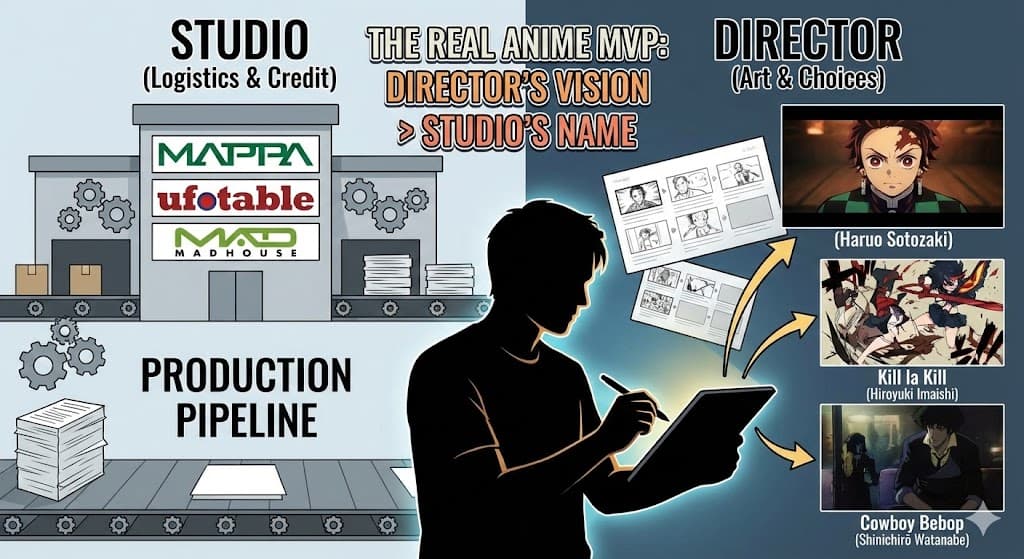
When we talk about anime, we usually credit the studio. "ufotable's Demon Slayer," "MAPPA's Jujutsu Kaisen," "Madhouse's Frieren."
But here's the uncomfortable truth: studios are credit machines. They're organizational structures. They coordinate production, pay staff, manage pipelines.
Directors are artists. They make the choices that define how anime feel, flow, and hit emotionally.
Yet most anime fans couldn't name five anime directors. That's a gap worth closing.
When you love a show, your brain automatically credits the studio. It's easy. One name. One entity.
But a studio like MAPPA produces dozens of anime simultaneously. Each one looks different. Each one has different pacing, color grading, shot composition, emotional beats.
How can the same studio produce Chainsaw Man (kinetic, dark, experimental) AND Blue Lock (clean, tactical, straightforward) AND Attack on Titan Final (epic, cinematic, introspective)?
Because different directors led each project. They made fundamentally different artistic choices.
The studio's job is logistics. The director's job is vision.
When a director takes on an anime, they shape:
Visual Language: How shots are framed, how the camera moves, what gets shown vs. suggested. Masashi Ishihama (Chainsaw Man) uses experimental angles and unsettling compositions. Haruo Sotozaki (Demon Slayer) uses dynamic, sweeping cinematography. Same studio, completely different visual feel.
Pacing: How fast scenes move, how long emotional moments sit. Some directors let scenes breathe (Ryū Nakayama in Spy x Family). Others cut aggressively (Daisuke Ashihara in Mob Psycho). This determines whether you feel rushed or engaged.
Tone: Comedy, drama, action-how they're balanced, when they happen. Directors decide if a moment is played for laughs or devastating weight. Same scene in two director's hands plays completely differently.
Sound Design: When music swells, when silence hits. Directors work with composers to decide emotional beats. The difference between a scene with music and a scene without music is entirely directorial choice.
Here are five directors whose names you should recognize:
Masaaki Yuasa-The experimental genius behind Ping Pong the Animation, Devilman Crybaby, and Inu-Oh. His style is instantly recognizable: fluid, distorted, emotionally raw. If anime feels like a fever dream, it's probably Yuasa.
Mamoru Hosoda-Director of Wolf Children, The Girl Who Leapt Through Time, and Belle. He specializes in family dynamics and coming-of-age stories. His films feel warm even when they're sad.
Keiichi Hara-Directed Miss Hokusai and the criminally underrated Colorful. His pacing is deliberate, his characters feel lived-in. He trusts the audience to sit with quiet moments.
Mitsuo Iso-Created Dennou Coil, a masterpiece of sci-fi worldbuilding. Known for meticulous attention to detail and realistic character animation. If you want grounded, thoughtful sci-fi, watch his work.
Naoko Yamada-Director of A Silent Voice and Liz and the Blue Bird. Her visual storytelling is subtle and devastating. She uses framing, lighting, and body language to convey emotion without dialogue.
When you credit the director, you understand WHY a show works. You start noticing patterns. You start seeking out directors whose style you love.
You realize that MAPPA didn't make Chainsaw Man feel unsettling-Ryū Nakayama did. ufotable didn't make Demon Slayer emotional-Haruo Sotozaki did.
Studios are infrastructure. Directors are artists. Start learning their names. Your appreciation of anime will level up instantly.
Weekly updates on the latest releases and announcements.
.jpg)

.jpg)