Voice actors making your favorite anime earn poverty wages. Why industry structure exploits talent and how it could change.
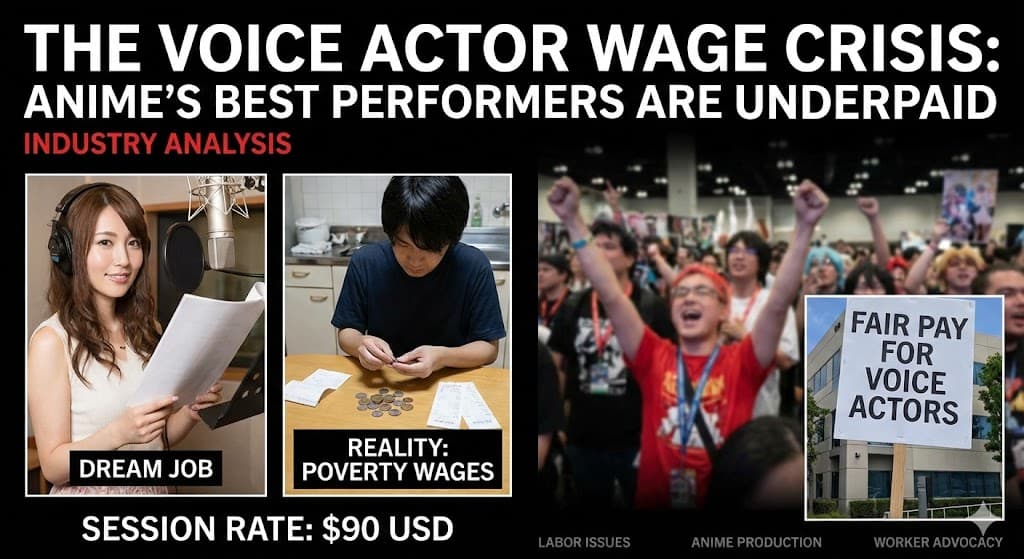
Anime voice acting is dream job for many. Prestigious, creative, beloved by fans.
It's also increasingly unviable as career.
Top-tier voice actors make livable wage. But mid-tier and newcomers? Working second jobs to survive on voice acting income alone.
Here's what the industry doesn't advertise.
Voice actors aren't paid per episode or per line.
They're paid session rate. For single recording session (typically 4-8 hours), voice actor receives flat fee. Whether session is 2 hours or 8 hours, compensation same.
Session rate: 13,500 yen ($90-100 USD) as baseline for non-established actors
For major productions, rates higher. But baseline remains shockingly low.
Calculate: One session per week = 4,500 yen monthly = roughly $300 USD per month.
Tokyo cost of living is comparable to New York. $300 monthly is not livable.
Historical: Dubbing was supplementary work. TV shows, foreign films, secondary market.
Studio system developed fixed rates. As anime became major industry, rates didn't scale.
Rather than reassess compensation, studios maintained historical rates. Now supporting entire industry of professionals at poverty wages.
Nobody benefited from change. So change hasn't happened.
Newcomers: Graduate from voice acting school, land first role. Earn $90 per session, maybe one session weekly. Monthly income: $400. Need side job.
Mid-Tier Professionals: Regular voice work, multiple sessions weekly. But only 10-12 sessions monthly average. Income: $1,200-1,500 monthly. Livable barely.
Established A-List: Multiple starring roles, film work, video game voice acting, commercial work. Income: $3,000-5,000+ monthly. Viable.
But climbing from mid-tier to A-list is gatekeeping problem. Limited A-list roles. Many talented professionals stuck at unsustainable income.
Let's be specific about what poverty wage means:
Tokyo rent: Average 1-bedroom apartment = 80,000-120,000 yen monthly ($600-900 USD)
Food, transport, utilities: Minimum 50,000 yen monthly ($375 USD)
Voice acting school debt: Many graduates owe 1-2 million yen ($7,500-15,000 USD)
Total minimum monthly cost: ~150,000 yen ($1,125 USD)
Mid-tier voice actor monthly income: ~180,000 yen ($1,350 USD)
Margin: Basically zero.
One medical emergency, one production delay, one missed session-financial crisis.
This isn't sustainable. Yet industry expects it.
Studios benefit from cheap labor: Why pay more when talented people accept current rates?
Union is weak: Japan's voice actor union exists but has limited negotiating power. Studios can bypass union entirely.
Supply exceeds demand: Thousands want voice acting careers. Studios can always find cheaper talent.
Fans don't know: Most anime viewers have no idea voice actors earn poverty wages. No public pressure for change.
Top-tier actors don't advocate: Established actors who could push for reform benefit from current system. They're paid well. Why risk it?
Raise session rates: Studios would need to allocate more budget to voice acting. Cuts into profit margins. Won't happen voluntarily.
Residual payments: Pay voice actors royalties based on show success (streaming views, merchandise). Industry resists. Opens complex accounting.
Stronger union advocacy: Requires collective action from voice actors willing to risk careers. Most can't afford to.
Public pressure: If fans knew and cared, they could pressure studios. But voice actor wages aren't sexy controversy.
Government regulation: Labor laws could mandate minimum viable wages. But anime industry lobbies against it.
Each solution requires someone powerful to sacrifice profit. Nobody will.
Burnout: Voice actors work multiple jobs. Recording sessions, retail work, tutoring. Sleep suffers. Mental health suffers.
Career abandonment: Talented voice actors quit because they can't afford to continue. Industry loses great talent.
Exploitation acceptance: Young voice actors accept exploitation as "paying dues." Normalizes abuse.
Health risks: Can't afford medical care. Voice is their tool. Throat problems, vocal strain-career-ending without treatment.
When you watch anime:
Voice acting quality will decline: As talented people leave for sustainable careers, average quality drops.
Established actors overwork: Same few A-list actors voice everything because they're only ones who can afford career.
Diversity suffers: Only wealthy people can afford to pursue voice acting. Working-class talent gets priced out.
Your favorite voice actor might quit: Many beloved mid-tier actors are one financial crisis away from leaving industry.
Unless something changes:
Or:
Which future happens depends on whether anyone with power decides to care.
Currently? Nobody in power cares enough to sacrifice profit.
That's the reality voice actors face
Weekly updates on the latest releases and announcements.